
Farmed and sun-cured as they were a century ago.
By Ari Weinzweig
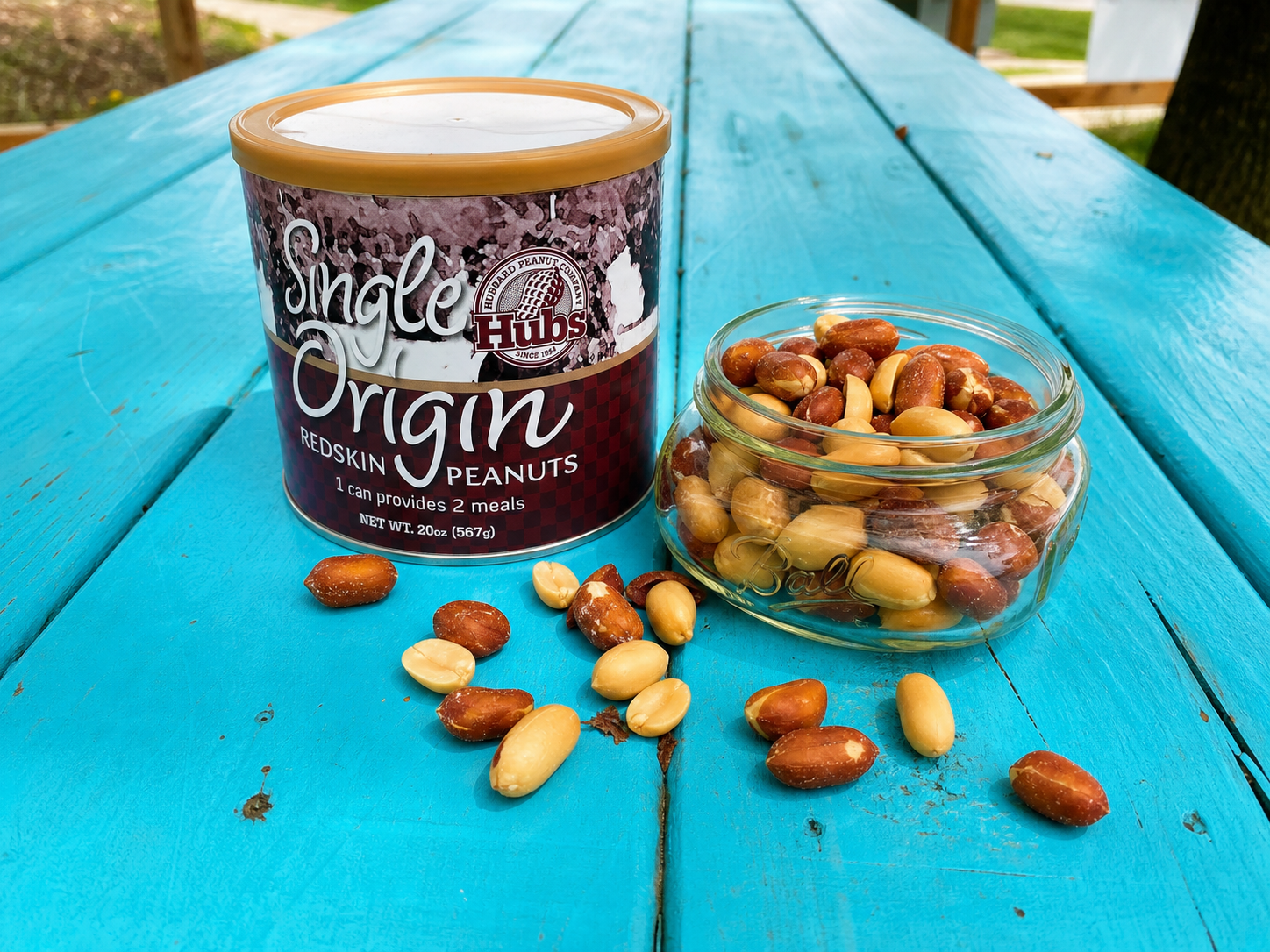
The amazing single-origin peanuts grown by Elisha Barnes—and shocked in the sun, just as they’re supposed to be—are available to snack on at the Roadhouse! I’m not normally a big peanut eater, but I found myself reaching back in the can over and over again to have a few more! The flavor, and the story behind them, have absolutely enhanced the energy in my internal ecosystem. I forecast they will have a similarly positive impact on yours!
The story behind Hubs peanuts.
Though they’re grown only by Barnes, the nuts come to us through the folks at Hubs, the third-generation Hubbard family farm in Farmville, Virginia. Back in the mid-1950s, Dot Hubbard helped develop what’s evolved over the years into the “specialty peanut market.” She took the extra time to hand-select the largest peanuts from each local farm’s delivery and then dip them in hot water before blister-frying them in her kitchen. She and her husband, H.J., began shipping their peanuts by mail, and now, nearly seven decades later, the company is run by their grandson, Marshall Rabil. Marshall has been working hard in recent years to take Hubs to new heights, and he, like we at Zingerman’s, has an affinity for small, specialty experiments, as well as a strong commitment to doing the right thing. Which is why there’s a very limited amount of these peanuts—and why I feel incredibly fortunate that we got our hands on them.
About the farmer, Elisha Barnes.
These single-origin peanuts are completely in line with our definition of quality, and epitomize our philosophical approach to food. They’re remarkably full-flavored—they have loads of complexity, balance, and finish. And they’re very traditional—this is the way high-quality peanuts would have tasted 100 years ago! They’re grown by Elisha Barnes, a fourth-generation farmer in Virginia. Barnes is beyond passionate about his peanut growing, and his connection to community, history, and the land. He’s been into it since he was a child: “The first time I got hooked on farming I was six years old.” Through farming and his upbringing, Barnes has developed a life philosophy that fits well with our own: “My father taught us how to treat people and how to be honest. He taught us integrity.” Both his passion and his principles are reflected in the excellence of the peanuts!
About Elisha’s 100-year-old approach to farming peanuts.
While Elisha Barnes’ farm isn’t certified organic, he uses no chemicals on the land. He harvests the peanuts using a 100-year-old picker, equipment he has had to modify regularly to make it work with his 50-year-old tractor. The peanuts are made particularly special because Barnes still uses the old way of curing them which is known as “shocking.” Just-dug nuts, left on the vine as they grew, are wrapped about around five-foot-high poles to sun-dry out in the field (think corn shocks). They’re left to cure for about six weeks before they’re brought in, cleaned, and brought to Hubs to get that patented blistering, roasting, and salting.
A hundred years ago, pretty much every peanut farmer worked this way. Today Elisha Barnes is the only one still doing it. It makes a big difference in the flavor. Barnes says, “It creates the sweetest, highest germination rate peanut there is. You see, [flash] drying takes out part of the germination quality, and it takes out the sweetness. It takes part of the quality out of the peanut. But I want to keep that.” In the spirit of a holistic internal ecosystem, Barnes says,
Tilling the soil, it teaches a spiritual lesson. Do your part, invest in the land and the land will give you an increase. We are a fourth-generation farm. My father, my grandfather, my great-grandfather all farmed peanuts. I am right now the only farmer anywhere around that actively shocks peanuts like this. … It’s rewarding. It’s an honor. Who would’ve ever thought that the son of a sharecropper would be standing on the land that he now owns and farming peanuts the way that my father and his father did. That speaks volumes for me.
I am indebted to Hubs for coming on board with me and allowing me to be able to raise this and allow it to be financially beneficial so that I can continue to do this growing. Hubs hopes the single-sourced specialty peanut will remind people of their roots. It has already given one farmer exactly what he needs! My daughter says that I’m a dinosaur that refuses to die. The chapters of my life will close with me farming the way I want to farm.
Supporting Elisha Barnes’ work is also a small step toward helping to restore the rightful place of Black farmers in the U.S. According to research, Black farmers have lost nearly 90% of their land over the last 100 years. “Southampton County, at the turn of the century, was primarily Black-owned,” Barnes explains. Now he is one of only a few Black farmers left working local land. A few years ago, he and his oldest brother bought back his father’s 52-acre spread in Courtland. “I raised peanuts on the family farm for the first time in 30 years,” he notes with pride.
Speaking of his commitment to traditional farming, Barnes says, “Maybe, just maybe, I’ll inspire somebody to take just a little bit of this old history and keep it alive.” Personally, I’m pretty confident his hope will be fulfilled many times over in the coming years. Swing by the Roadhouse soon to enjoy some of these stellar peanuts (with $2 oysters for Happy Hour from 2 to 6 p.m. Monday through Friday)! The flavor is big, but supplies are limited. Savor every exceptional nut!
[/et_pb_text][/et_pb_column]
[/et_pb_row]
[/et_pb_section]